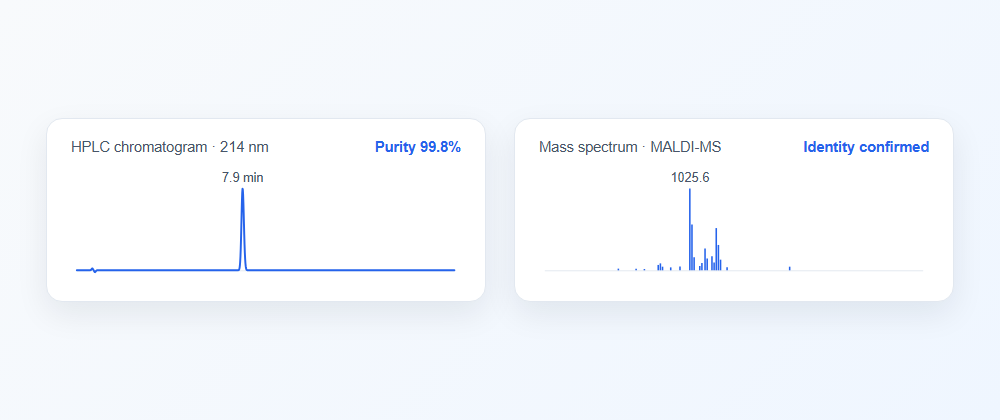
A small team running peptide-based research has a lot riding on its starting materials. If a peptide is impure or is not the sequence that was ordered, weeks of work can be wasted. Third-party testing is a quick way to check.
Check what you bought before you use it
Supplier certificates are a starting point, but they come from the party selling the product. An independent test gives you your own numbers. We measure purity with RP-HPLC (UV 214 nm) and confirm identity by molecular weight with MALDI-MS, on two separate instruments.
Spot lot-to-lot differences
Peptide synthesis can vary from batch to batch. Testing each new lot shows whether purity has changed and confirms the molecular weight still matches. Comparing chromatograms across lots makes changes easy to see.
Add safety tests when you need them
Depending on how a material will be used, teams may also want endotoxin ($200), sterility ($250), heavy metals ($175) or pH ($30) testing. These can be added to the same order.
Know what the numbers mean
- Purity is the main peak's share of the HPLC chromatogram at 214 nm. It is not the amount of peptide in the vial.
- Identity is a match between the measured and expected molecular weight.
- Content (quantitation) is a separate $25 add-on that estimates how much peptide is present. A full vial is needed to confirm total content.
Keep a record you can share
Each ZyntroTest COA includes the chromatogram and mass spectrum and has a COA number that collaborators can verify online. Testing is $200 per sample with results in 3–5 business days, and volume discounts start at 15 samples.