Peptide testing used to mean one thing for many sellers: run the sample on HPLC and report a purity percentage. That number is useful, but it can be misleading on its own. Here is why we treat purity and identity as two separate checks.
Check 1: purity by RP-HPLC
We measure purity with reversed-phase HPLC and a UV detector at 214 nm. The peptide and its related impurities, such as shorter synthesis fragments, separate on the column and show up as peaks. Purity is the main peak's share of the total peak area.
This tells you how clean the sample is. It does not tell you what the main peak is.
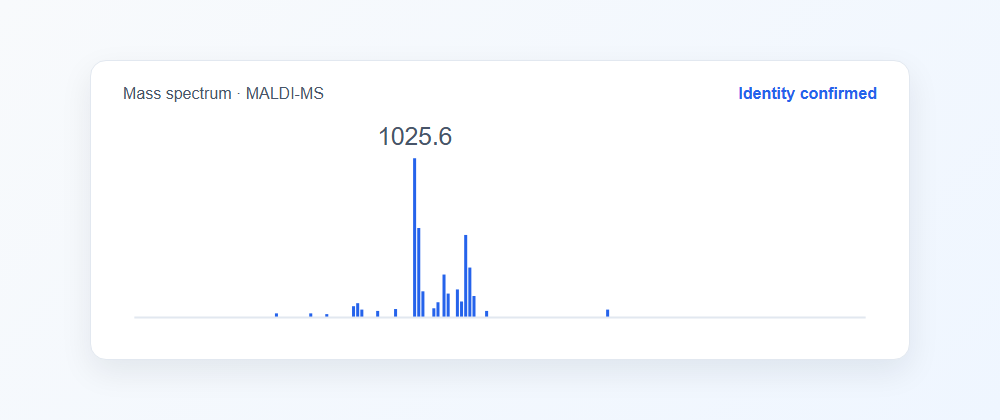
Check 2: identity by MALDI-MS
We confirm identity on a separate instrument, a MALDI mass spectrometer. It measures the molecular weight of the sample, and we compare that with the expected weight of the labeled peptide. If they match, identity is confirmed. If they do not, the COA says so.
Why one check is not enough
- Wrong peptide, high purity: a vial can hold a clean sample of the wrong compound. HPLC alone would report a high purity number.
- Right peptide, low purity: mass spec alone can confirm the peptide is present without telling you how much of the sample is impurities.
- Both checks together: you learn that the sample is the right peptide and how pure it is.
Blends
Blends are tested at the same flat rate as single peptides. The chromatogram and mass spectrum show each component, so you can see what is in the vial.
How much the vial contains
Purity is a percentage, not an amount. If you also want to know how much peptide is in the vial, add content (quantitation) testing for $25. A full vial is needed to confirm total content, because the result applies only to the sample we receive.
What you get
Every ZyntroTest peptide COA reports purity by RP-HPLC and identity by MALDI-MS, includes the chromatogram and mass spectrum, and can be verified online by its COA number. Testing is $200 per sample with results in 3–5 business days.