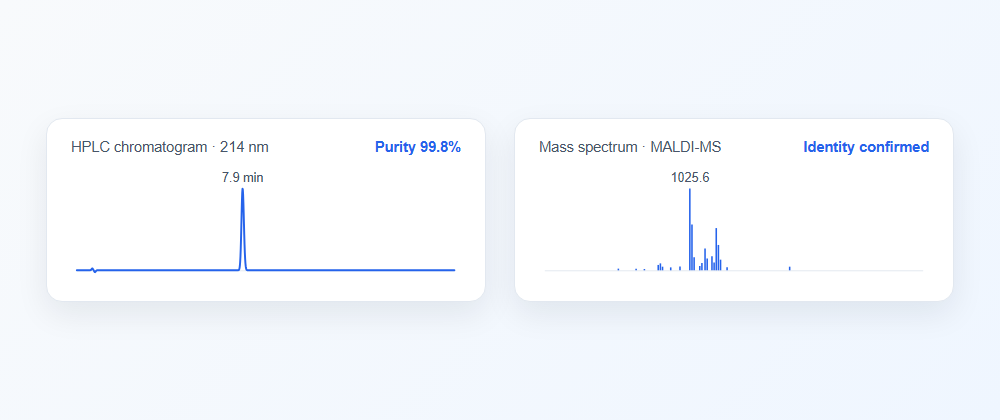
When people compare "HPLC vs. mass spec," it can sound like one method is better than the other. In practice they do different jobs. Here is what each one measures, where each one falls short on its own, and how we use them together.
What RP-HPLC measures: purity
Reversed-phase HPLC (RP-HPLC) pushes the dissolved sample through a column that holds back molecules by how water-repelling they are. The target peptide and its related impurities come off the column at different times. A UV detector set to 214 nm, where the peptide bond absorbs light, records each one as a peak.
Purity is the area of the main peak divided by the total area of all the peaks. If the main peak makes up 98.6% of the total, the sample is reported as 98.6% pure. This is the standard, well-understood way to measure peptide purity, and it is very good at showing how many related impurities are present and how large they are.
What HPLC alone cannot tell you: identity
A UV detector does not know what a molecule is. It only sees that something absorbed light at a certain time. If a vial contains the wrong peptide, or a peptide that is close to the right one, HPLC can still show one clean, tall peak and a high purity number. Retention time hints at identity, but it does not prove it.
What MALDI-MS measures: identity
MALDI-MS (matrix-assisted laser desorption/ionization mass spectrometry) measures the mass of the molecules in the sample. The sample is mixed with a matrix, dried on a target plate and hit with a laser, which lifts intact peptide ions into the instrument. The instrument records their mass-to-charge ratio, and for peptides the main signal usually corresponds to the intact molecule plus one proton.
We compare that measured mass with the expected molecular weight for the peptide on the label. A match confirms identity. A mismatch, or extra major signals at unexpected masses, tells you something is wrong even if the purity number looked fine.
Why we run them on two separate instruments
At ZyntroTest, purity and identity come from two different instruments: RP-HPLC with UV detection at 214 nm for purity, and a MALDI mass spectrometer for identity. Keeping them separate means each measurement is done the way that instrument does best, and both results go on your COA with the chromatogram and the mass spectrum.
What this means for your COA
- Purity: the percentage from the HPLC chromatogram, measured at 214 nm.
- Identity: the measured molecular weight from MALDI-MS compared with the expected value.
- Evidence: the chromatogram and mass spectrum, so the numbers can be checked.
- Verification: a COA number anyone can look up on our COA verification page.
If a COA you have been given shows a purity number but no mass result, you know how pure the sample is, but not what it is. That is the gap two instruments close.