Sellers of peptides and other research materials are asked more and more often for independent test results. Here is what third-party testing is, why it carries weight, and what a good independent report looks like.
What "third-party" means
A first-party report comes from the company that made the product. A second-party report comes from the buyer or someone working for them. A third-party report comes from an independent lab with no financial interest in whether the product passes. That independence is what makes the result believable.
Why sellers use it
- Buyer confidence: customers can see results that did not come from the seller.
- Supplier checks: sellers can confirm that what their supplier shipped matches what was ordered.
- Lot-to-lot consistency: testing each lot shows whether quality is changing over time.
- A record: a dated, lot-specific report is useful if a question comes up later.
What we test
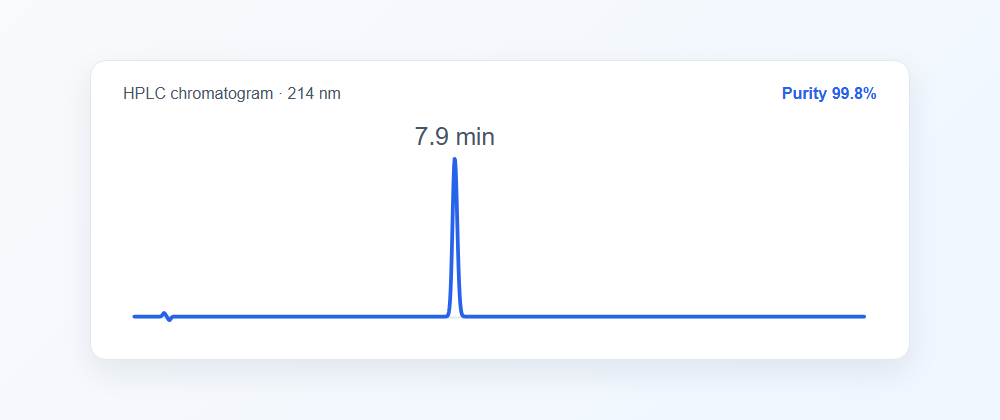
ZyntroTest focuses on peptides. Every sample gets purity by RP-HPLC (UV 214 nm) and identity by MALDI-MS on two separate instruments, for $200 per sample. You can add content (quantitation, +$25), endotoxin ($200), sterility ($250), heavy metals ($175) and pH ($30) testing.
What a good independent report shows
- The lab's name and how to reach it.
- The lot number and the date the sample was received.
- The methods used and the results, with the chromatogram and mass spectrum.
- A way to verify the report with the lab. Every ZyntroTest COA can be checked on our COA verification page.
What a report cannot do
Results apply only to the sample the lab received. A COA for one lot says nothing about another lot, and a small sample cannot confirm how much peptide a full vial contains. That is why lot-specific testing matters.